
Workshop
The workshop is a converted garage: heated, air-conditioned, with controlled humidity. Inside there are two beech workbenches, a bandsaw, a drill press, a router and a full set of hand planes, chisels and saws. Every station has dust extraction, and there are no lacquers in here — only oil and shellac. I print my own jigs.
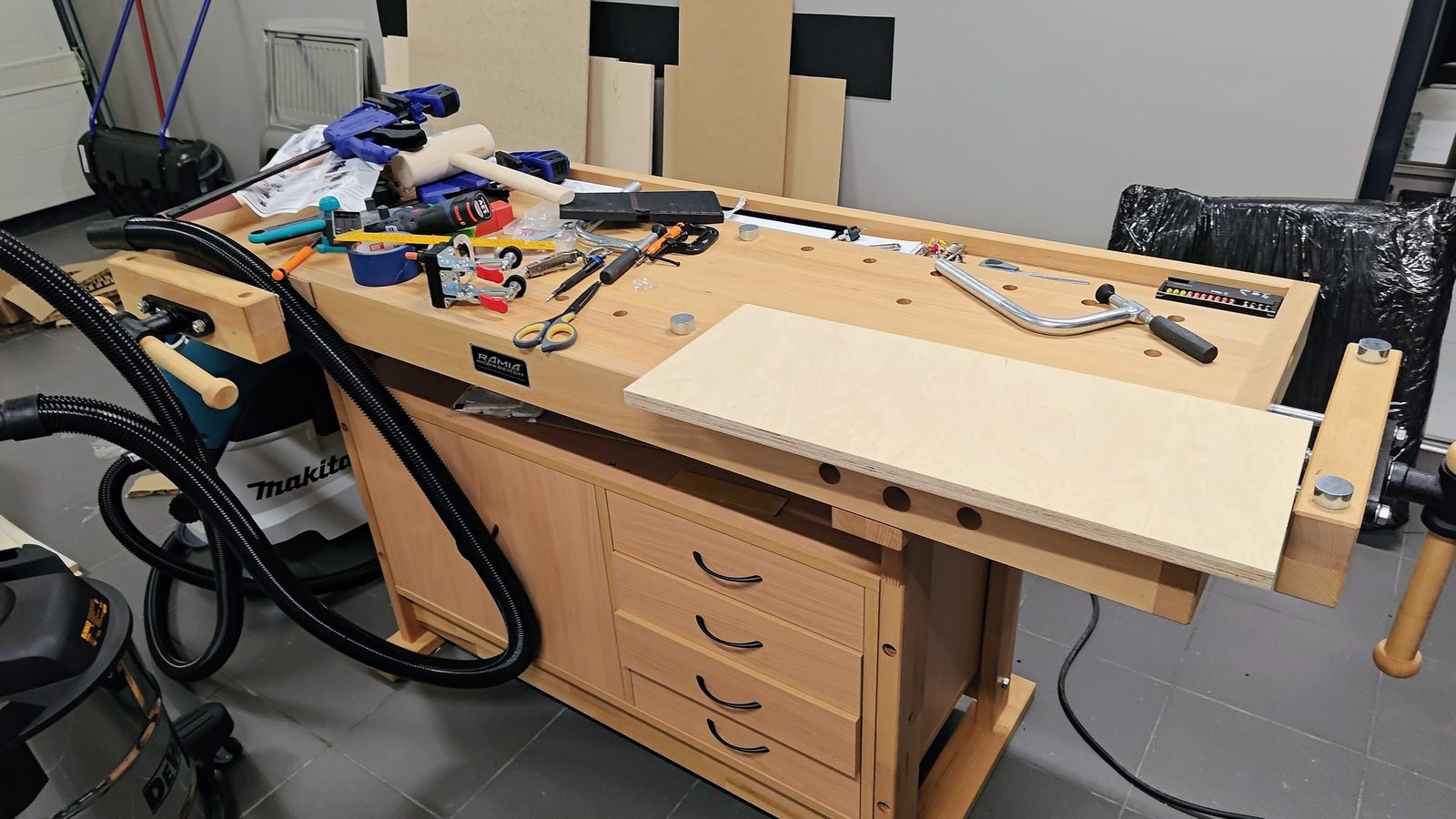
The workshop started as a garage. The car moved out, and in its place moved in the things you can’t build guitars without: stable temperature, stable humidity and plenty of light. The rest is just tools.
01Climate
Instrument wood doesn’t forgive swings in humidity. A plate glued up at 60% RH and dried down to 35% will crack — not “might crack”, will crack. That’s why the climate was the first investment, before any machine. The garage is heated and air-conditioned and holds 21–22°C all year round. Humidity is watched by an Inkbird IHC-200 hygrostat, which controls a dehumidifier and a humidifier (Beurer LB 55) — one kicks in when it gets too damp, the other when it gets too dry. The target is 47% RH. Next to it hangs an independent TFA Klima Bee hygrometer, to check that the automation isn’t lying. Instrument wood sits in this climate for weeks before I touch it.
02Benches
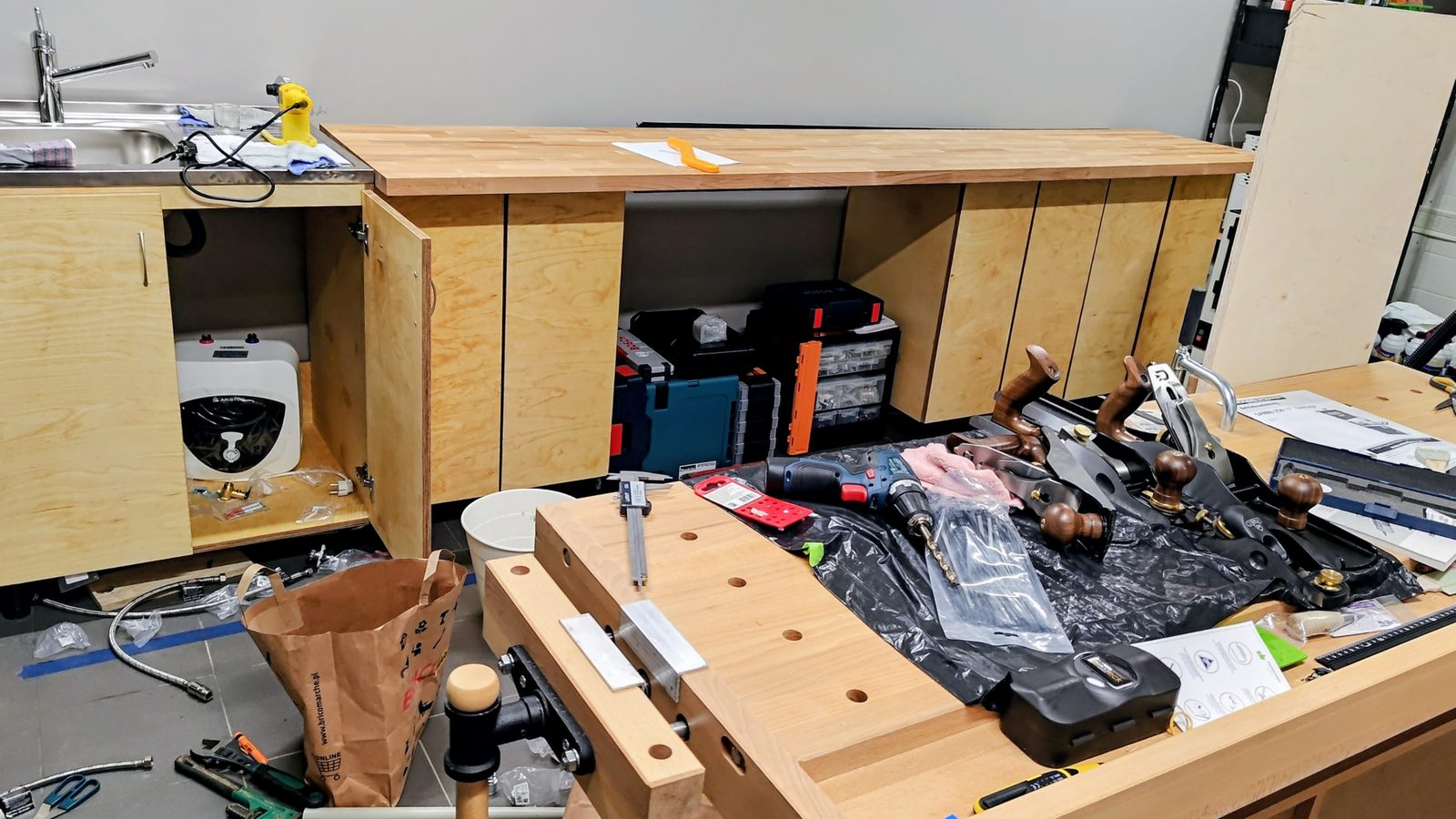
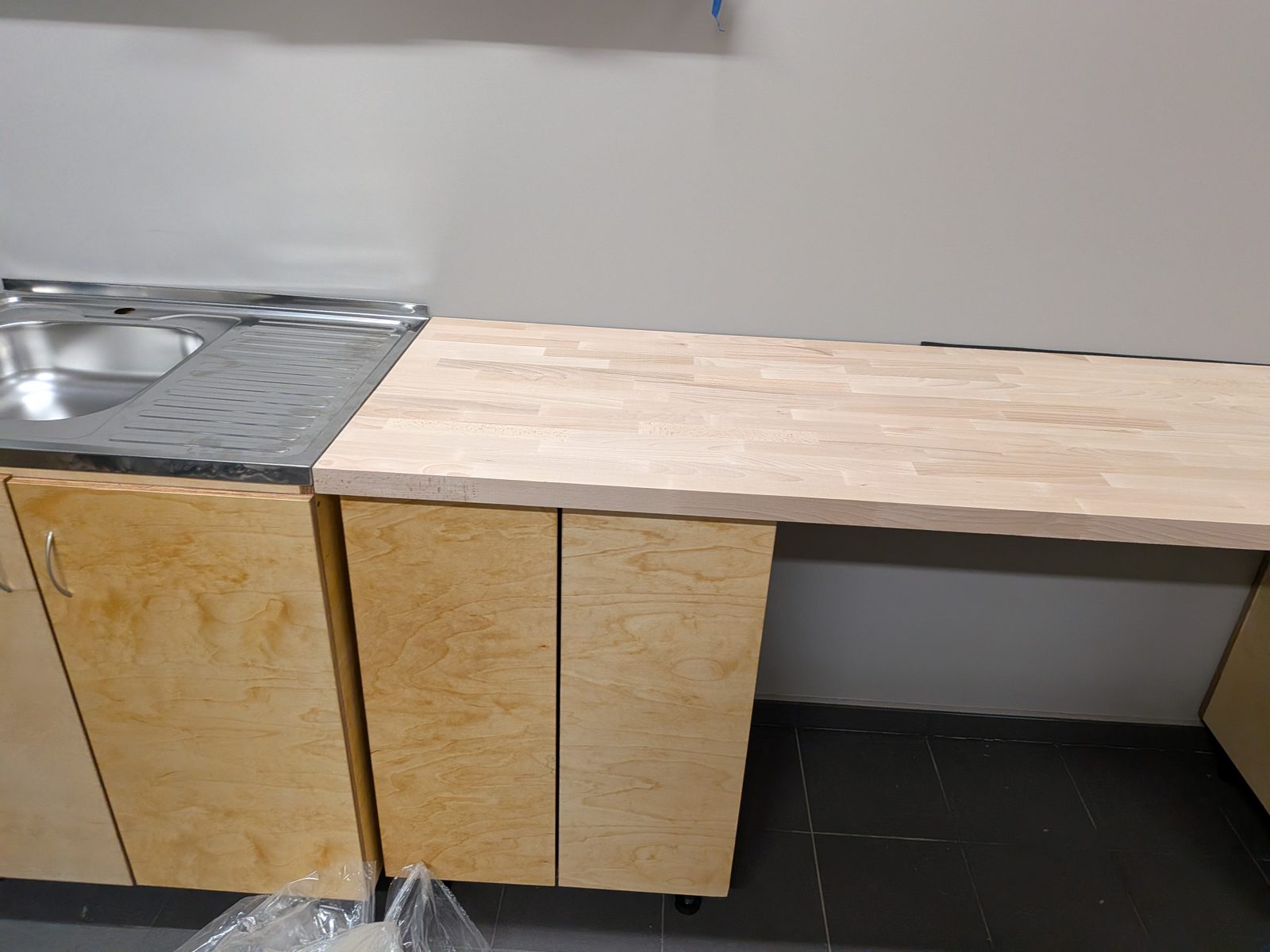
The heart of the workshop is a beech Ramia Diamond 1800 Combo joiner’s bench — heavy, with a front vise and a side vise, and dog holes for holdfasts. Everything that needs planing and force happens there. The second bench I made myself: a three-metre beech top, 62 cm deep, hung on the wall on plywood cabinets of my own making. The bandsaw and the drill press sit on it, and the free section is earmarked for a go-bar deck — threaded rods in the top, a plate above, the radius dish on the bench. A third bench is planned, purely for assembly: a plywood carcass full of drawers and a glued-up beech top.
03Machines
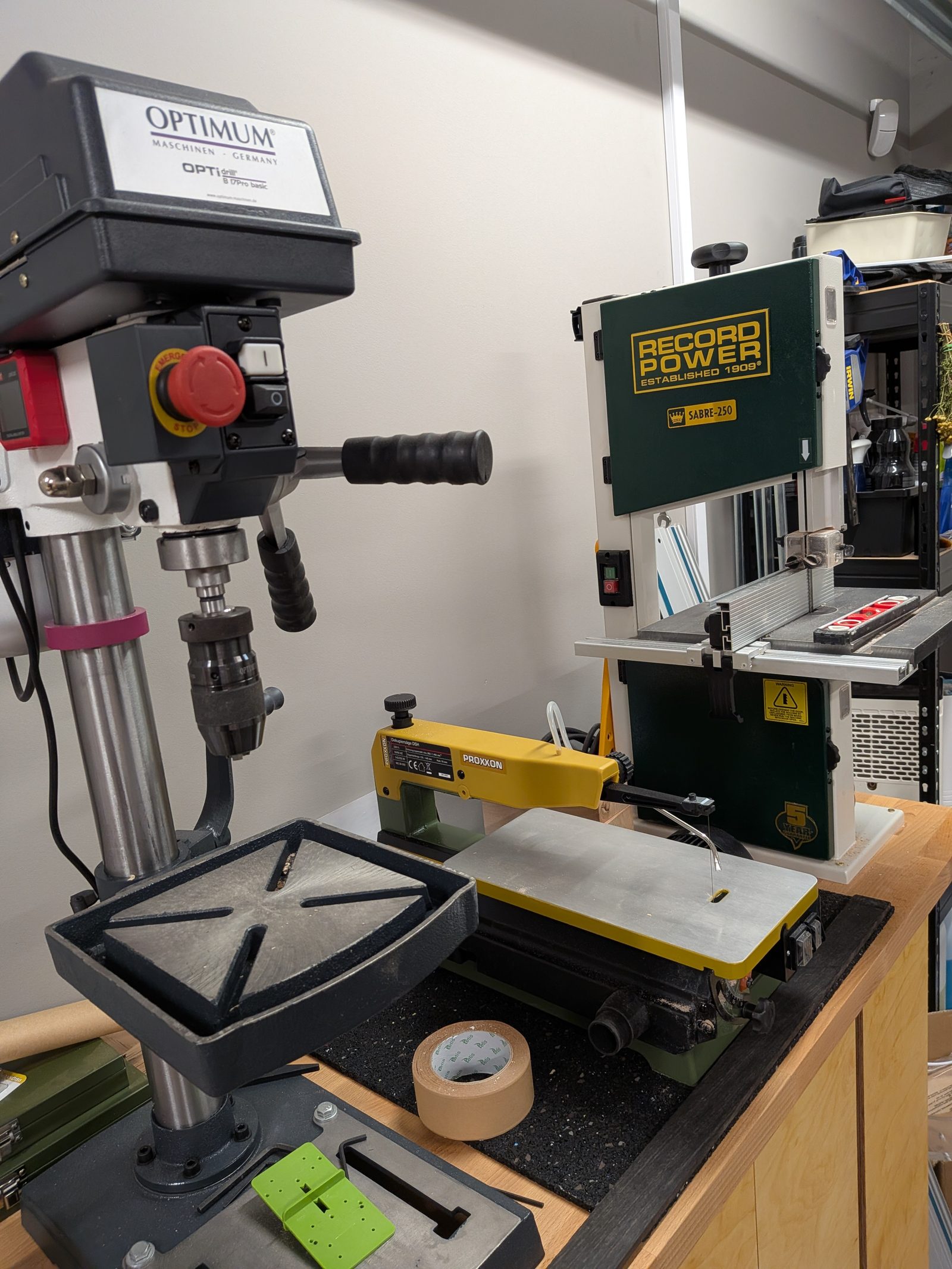
There aren’t many, and that’s on purpose. A Record Power Sabre 250 bandsaw — for cutting out plates, sides, blocks, anything that needs to come out of a board. An Optimum OPTIdrill B17Pro drill press. A Makita RT0702CX2J router with a set of Wealden bits — for the rosette, the soundhole, the truss rod channel and the bindings. Plus a Dremel, a Bosch jigsaw and a 12 V cordless driver, i.e. the things anyone who does anything in wood has. Side bending — a Luthier’s Bench bending iron.
04Hand tools
This is where I spent the most relative to how little space it takes up, and I don’t regret it. A full set of Dictum SK4 planes — a #4, a #62 low-angle, a #7 jointer for edge joints, a shoulder plane and two spokeshaves — plus a Pinie scrub plane for the rough work. Z-Saw Japanese saws. Stubai, Kirschen and Narex chisels. For sharpening, Shapton stones and DMT plates with a Veritas Mk II honing guide, because a dull chisel isn’t a saving, it’s torn-up wood.
05Dust and air
Lutherie is sanding, and sanding is dust. There’s extraction at every station: a Makita VC4210M with an Oneida Dust Deputy cyclone for the power tools, and a Record Power AC400 as an air filter above the bench. I try to keep dry sanding to a minimum and always do it under extraction — the workshop is meant to be a place for gluing, planing and finishing, not one where everything is coated in a layer of wood flour. For the same reason, there are no lacquers in here. The finish is shellac and oil — things that don’t call for a respirator. Oily rags are single-use: at the end of the day they dry spread out flat outdoors, then go in the bin. Linseed oil in a bunched-up rag can ignite on its own, and that’s no legend.
06The printer
On the shelf sits a Bambu Lab P2S with AMS. It’s not a whim: most of the jigs — the fret slotting box, the centre finder, radius blocks, templates — I design myself and print on the spot, instead of ordering them from across the ocean.
07What’s missing
For now: the extra assembly bench — already being designed — and a drum sander, which will be DIY.