
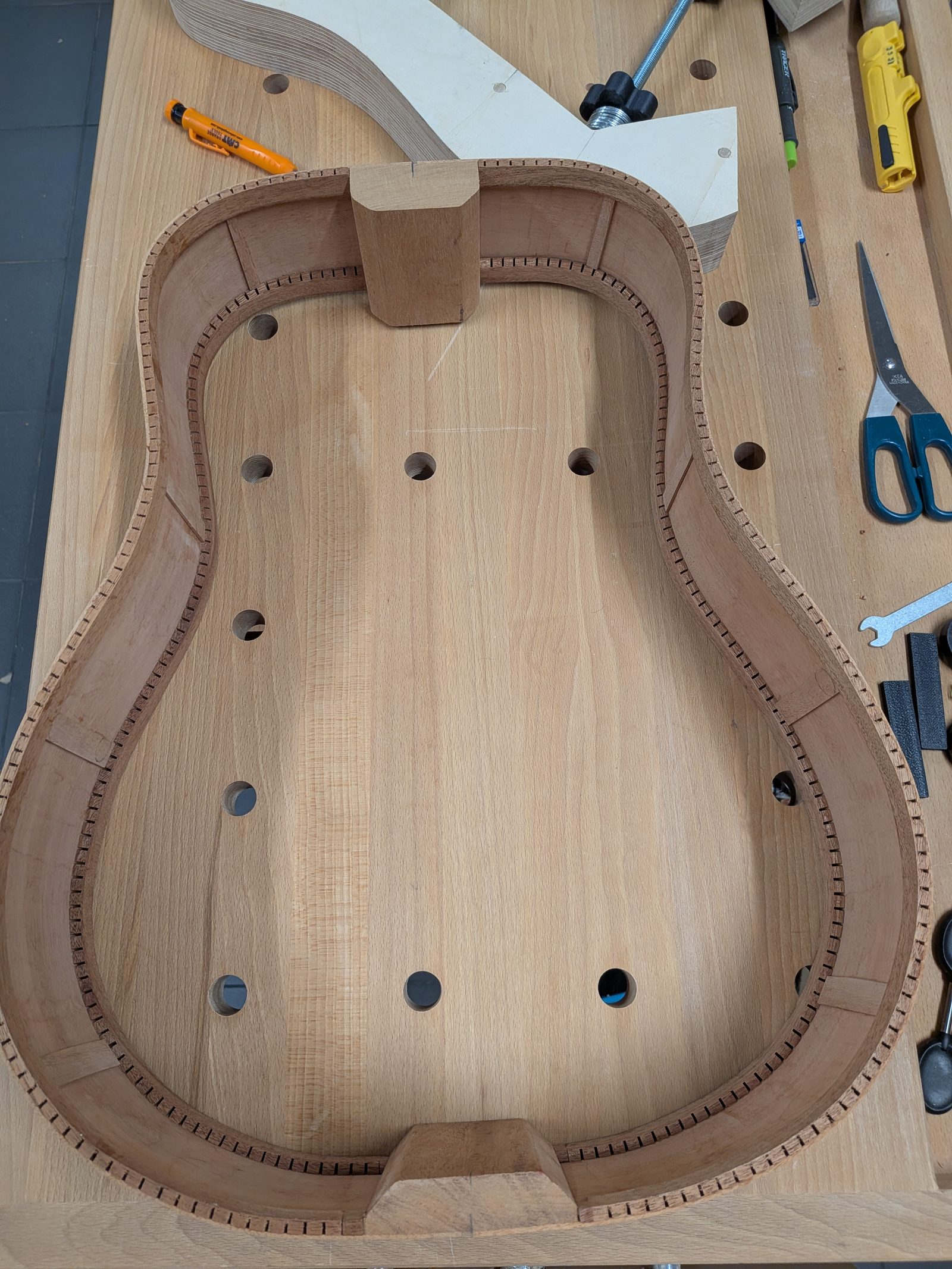
A closed rim looks like a guitar, but its edges are still flat — and the top and the back won’t be. Both are slightly arched, each differently: the back more, the top less. For the sides to sit against such plates all the way round, their edges have to get exactly the same curvature. That’s what the radius dish is for: a large disc shaped to a section of a sphere, with sandpaper on top. The radii: 15' for the back, 28’ for the top.
The work itself is simple and hypnotic. Rim in the mold, mold on the dish, and you move it around in circles, pressing down evenly. The sandpaper takes off whatever sticks out the most first — the middle of the sides, near the blocks — and with every turn the sanded area spreads around the whole perimeter. When the pencil line I’d drawn along the entire edge beforehand disappears evenly everywhere, the profile is done. Then the same on the other side, on the other dish.
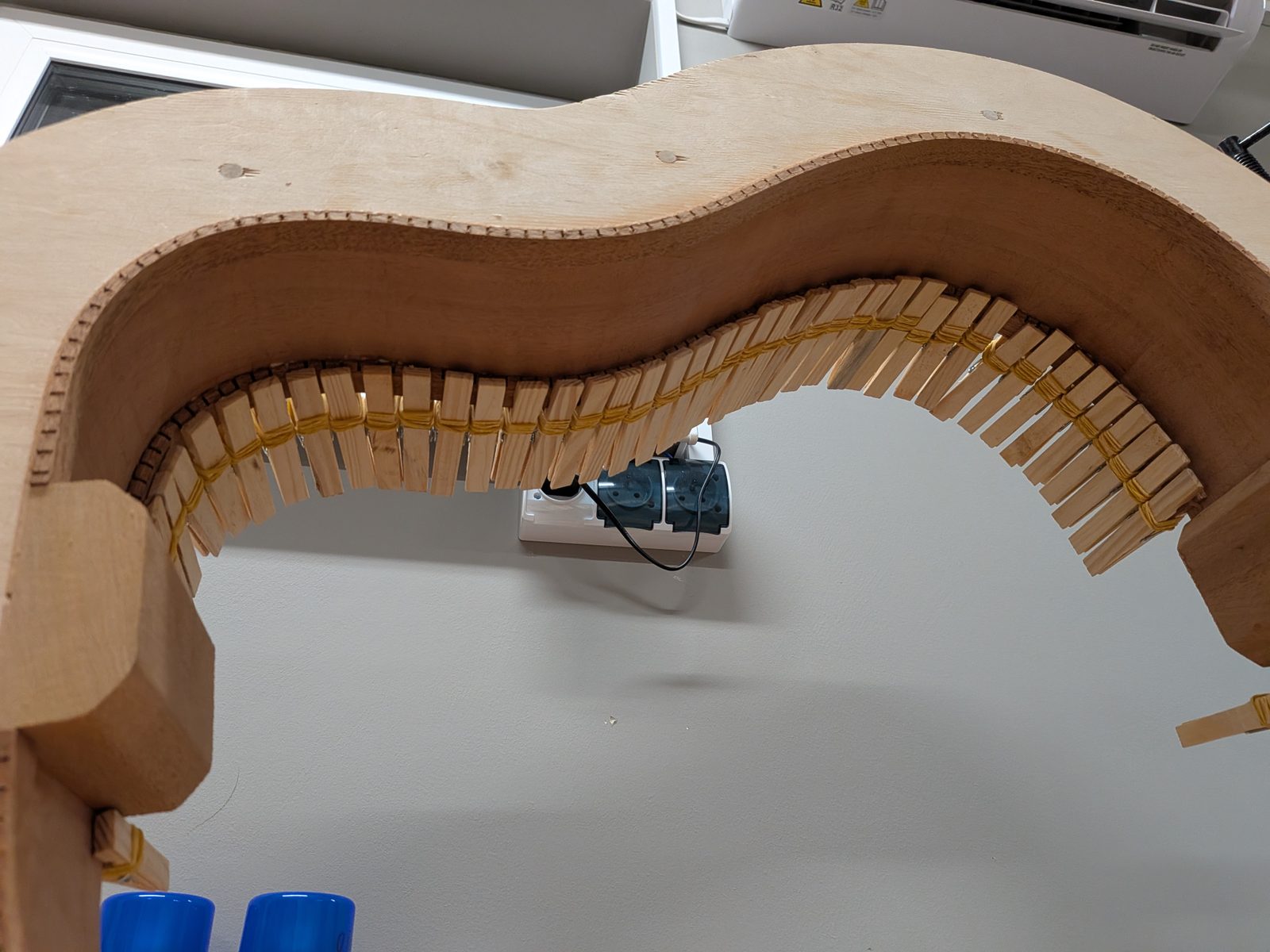
A side is 2.1 mm thick. That’s not enough of an edge to glue a plate to — the glue has nothing to hold on to. That’s why linings are glued along the whole perimeter on the inside: kerfed linings, or simply kerfing. Mine are strips of mahogany, slotted closely almost all the way through, so they can follow the curve of the side without being heat-bent. I decided to use reverse kerfing — with the slots facing the side — which adds extra stiffness to the whole rim.
Gluing means dozens of small clamps. In my case, wooden clothes pegs with rubber bands. I glued the linings slightly proud of the edge of the sides, and then the whole thing went back onto the radius dish to sand them flush with the sides — this way the gluing surface for the plate has its full width and the same arch all the way round.
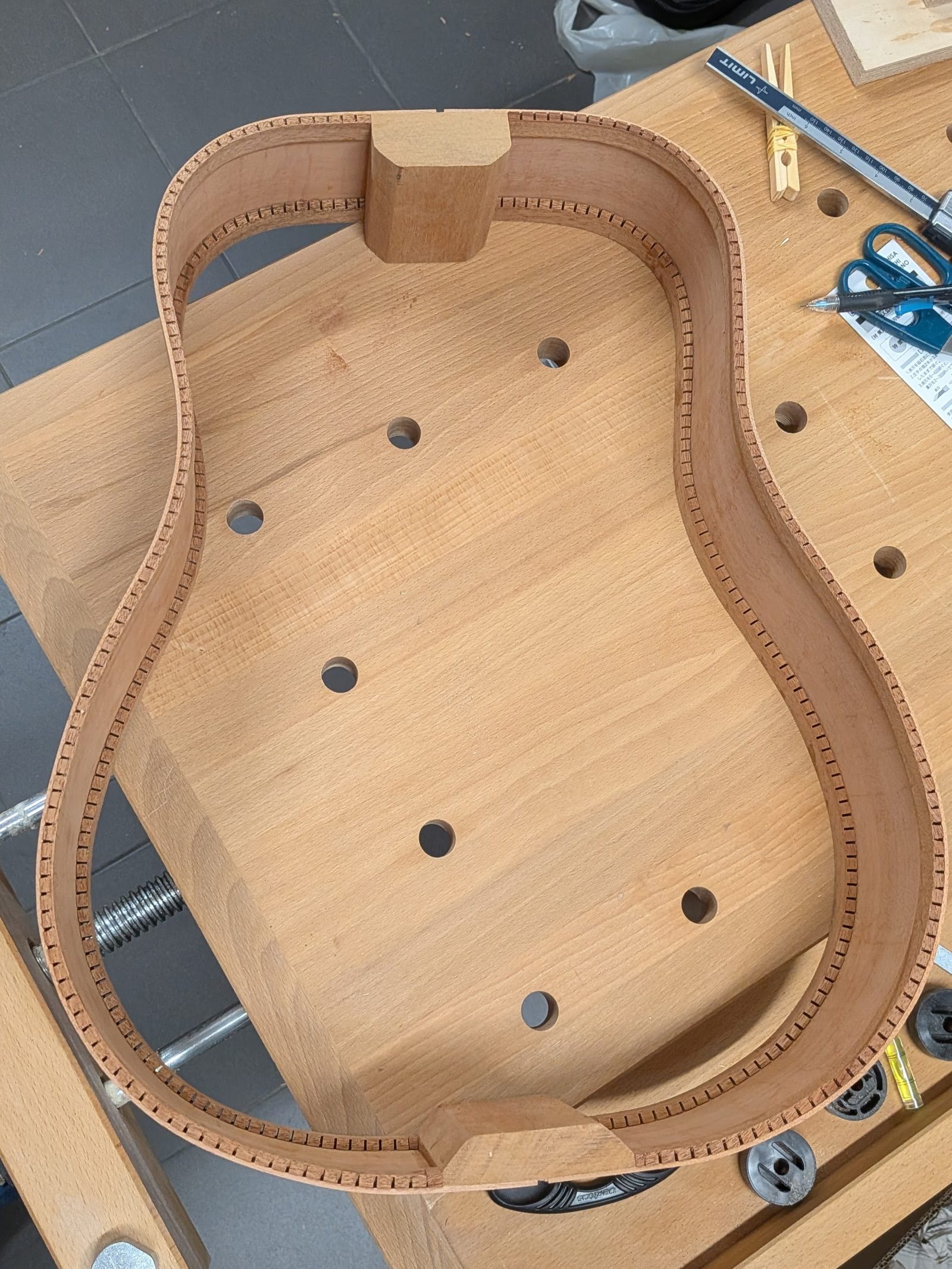
Finally, side braces. After bending and thicknessing to 2 mm a side is thin and its grain runs lengthwise — if it ever cracks from a knock or from drying out, the crack likes to run along the grain across the full height of the side. Cross braces of mahogany, glued on the inside every ten-odd centimetres between the top and bottom linings, stop such a crack within a single section. They’re not visible from outside and they don’t affect the sound, but they’re one of those things that set apart an instrument built properly from one built quickly.
The rim is ready. Next step: the end graft.